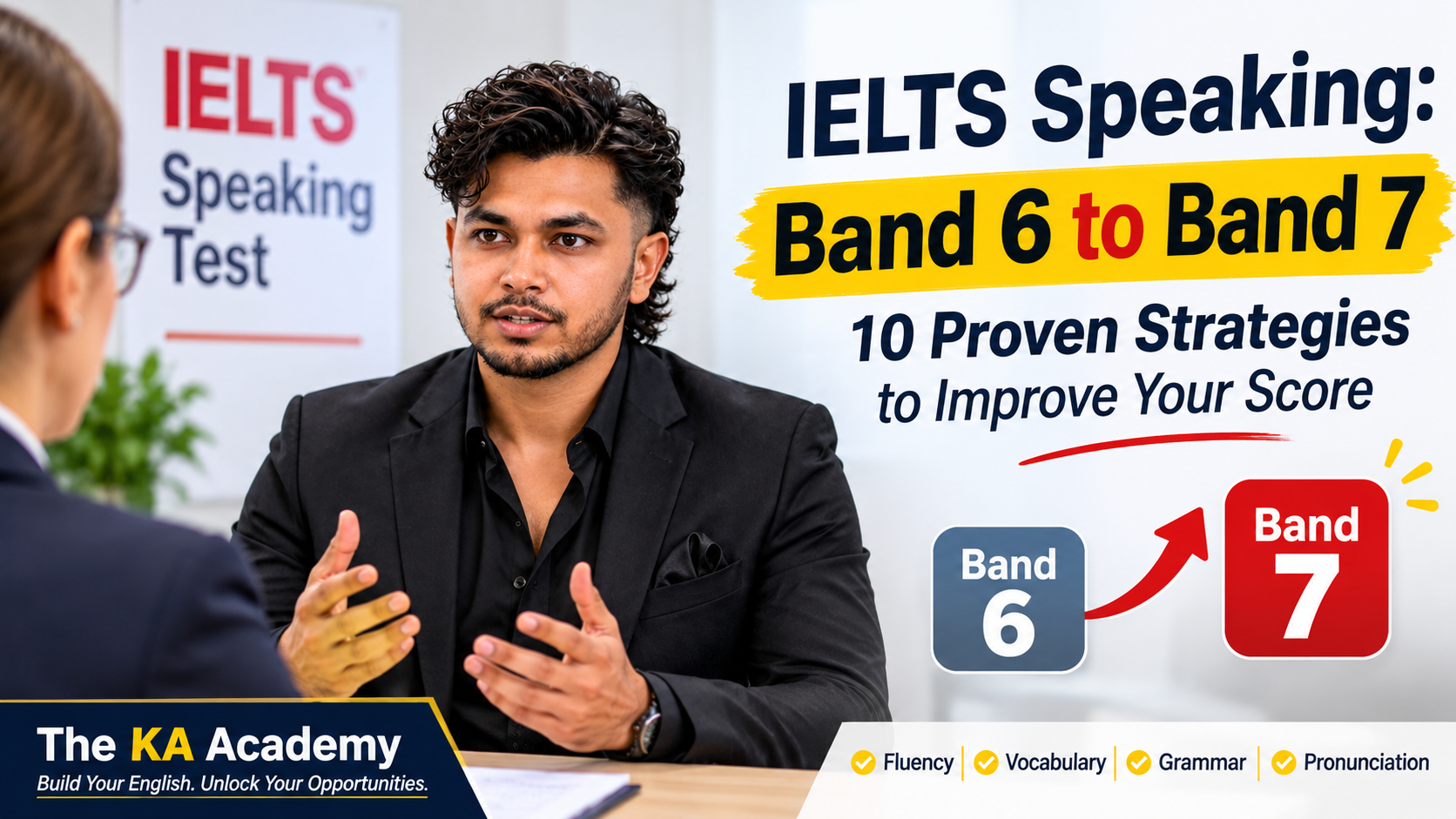
How to Improve IELTS Speaking from Band 6 to Band 7: 10 Proven Strategies
Introduction: Why Are You Stuck at IELTS Speaking Band 6?
Have you been preparing for IELTS Speaking for weeks or even months, but your score remains stuck at Band 6 or 6.5?
You can understand English movies, read international newspapers, communicate with people, and even use advanced vocabulary. However, when you receive your IELTS Speaking result, the score does not reflect your expectations.
This is a frustrating experience for many IELTS candidates in Bangladesh.
But why does it happen?
The problem may not be your overall English knowledge. It could be your speaking technique, lack of confidence, limited vocabulary, grammatical inaccuracies, or insufficient speaking practice.
The good news is that moving from Band 6 to Band 7 is achievable with the right preparation strategy.
In this guide, The KA Academy explains 10 practical strategies to help you improve your IELTS Speaking performance and move closer to your target score.
Enroll today to speak like a native
Understanding the Difference Between IELTS Speaking Band 6 and Band 7
Before improving your score, you need to understand what separates a Band 6 speaker from a Band 7 speaker.
IELTS Speaking is assessed according to four criteria:
Fluency and Coherence: How smoothly and logically you communicate your ideas.
Lexical Resource: How effectively and accurately you use vocabulary.
Grammatical Range and Accuracy: Your ability to use different grammatical structures correctly.
Pronunciation: How clearly and naturally you pronounce words and express meaning.
A Band 6 speaker can generally communicate successfully but may experience hesitation, repetition, limited flexibility, or noticeable grammatical errors.
A Band 7 speaker demonstrates greater flexibility, speaks at length with less effort, uses a wider range of vocabulary, and produces frequent error-free sentences.
Remember, Band 7 does not mean speaking perfect English or using complicated words in every sentence. It means communicating effectively, naturally, and confidently.
10 Proven Strategies to Improve IELTS Speaking from Band 6 to Band 7
1. Stop Memorising Answers and Start Speaking Naturally
One of the most common IELTS Speaking mistakes is memorising prepared answers.
Many candidates collect answers from YouTube, coaching centres, Facebook groups, and websites. They attempt to reproduce these answers during the examination.
Unfortunately, memorised responses can sound unnatural and may not directly answer the examiner’s questions.
Practise explaining the same idea in different ways.
Avoid repeating scripted answers.
For example:
Question: Do you enjoy reading books?
Less effective answer: Yes, I enjoy reading books because books are very important in our life and they provide us with knowledge.
More natural answer: Absolutely! I particularly enjoy reading novels because they allow me to explore different cultures, perspectives, and human experiences. I usually read before going to bed, as it helps me relax.
The second answer is more developed, specific, and natural.
2. Develop Your Fluency Through Daily Speaking Practice
Fluency is not about speaking as quickly as possible. It is about expressing your ideas smoothly without unnecessary hesitation.
If you frequently pause to translate Bangla sentences into English, your fluency may suffer.
Try these daily exercises:
Speak in English for 10–15 minutes every day.
Describe your daily activities in English.
Talk about current events and familiar topics.
Record yourself speaking for two minutes.
Listen to your recordings and identify unnecessary pauses.
A useful exercise is the two-minute speaking challenge.
Choose a random topic, set a timer for two minutes, and speak continuously. Do not stop whenever you forget a word. Try explaining the same idea using different expressions.
Consistency matters more than practising for several hours once a week.
3. Expand Your Vocabulary Without Using Difficult Words Unnecessarily
Vocabulary plays an important role in achieving IELTS Speaking Band 7.
However, learning hundreds of complicated words will not automatically improve your score.
You need to learn vocabulary that you can use accurately and naturally.
For example:
Basic expression
More flexible expression
Very important
Essential / Crucial
Very beautiful
Stunning / Attractive
Very difficult
Challenging / Demanding
Very interesting
Fascinating / Engaging
Good for society
Beneficial to society
Make something better
Improve / Enhance
How to improve your vocabulary:
Learn vocabulary by topic.
Study collocations rather than isolated words.
Learn synonyms and paraphrasing techniques.
Use new expressions in your own sentences.
Maintain a personal vocabulary notebook.
For instance, instead of repeatedly saying “I like travelling,” you can say:
“I am particularly fond of travelling because it gives me an opportunity to explore unfamiliar places and experience different cultures.”
The objective is not to impress the examiner with difficult vocabulary. It is to communicate your ideas precisely.
Grammar is another important factor in IELTS Speaking.
Many Band 6 candidates rely heavily on simple sentences. Others attempt complex grammatical structures but make frequent mistakes.
To reach Band 7, you should demonstrate a wider range of grammatical structures while maintaining accuracy.
Practise using:
Simple sentences
Compound sentences
Complex sentences
Conditional sentences
Relative clauses
Different verb tenses
Modal verbs
Example:
Basic: I prefer living in a city because there are many opportunities.
Improved: Although city life can sometimes be stressful, I prefer living in an urban area because it offers better educational and professional opportunities.
Notice how the second sentence combines different grammatical structures to communicate a more developed idea.
However, do not force complicated grammar into every answer. Accuracy and natural communication are more important.
Test your speaking now
5. Learn How to Develop Your Answers in All Three Speaking Parts
Understanding the IELTS Speaking test format is essential.
The examination has three parts, and each requires a slightly different approach.
Part 1: Introduction and Interview
You will answer questions about familiar topics such as your hometown, education, work, hobbies, and daily routine.
Avoid answering with only “Yes” or “No.”
For example:
Question: Do you like cooking?
Answer: Yes, I do. Although I am not an expert cook, I enjoy preparing simple meals at home, especially during weekends.
Keep your answers natural and relevant.
Part 2: Individual Long Turn
You will receive a topic card and have one minute to prepare. Then, you will speak for up to two minutes.
To organise your response:
Introduce the person, place, event, or object.
Explain the background.
Describe relevant details.
Include a personal experience.
Conclude with your feelings or opinion.
Do not try to memorise an entire speech. Develop a simple structure and speak naturally.
This section involves more abstract and analytical questions.
You may be asked to discuss education, technology, society, culture, the environment, or social changes.
A useful answer structure is:
Opinion + Reason + Example + Explanation
Example:
Question: Do you think technology has changed education?
Answer: Definitely. I believe technology has made education more accessible because students can now attend online classes and access educational resources from almost anywhere. For example, students living in rural areas can learn from experienced teachers through online platforms. As a result, geographical limitations are becoming less significant in education.
6. Work on Your Pronunciation, Not Your Accent
You do not need to speak with a British, American, or Australian accent to achieve IELTS Speaking Band 7.
IELTS assesses how effectively and clearly you communicate, not whether you imitate a particular accent.
Focus on:
Correct word stress
Sentence stress
Clear vowel and consonant sounds
Natural intonation
Appropriate pauses
Connected speech
For example, practise reading short paragraphs aloud and recording your voice.
Listen carefully to identify unclear words, unnatural pauses, and pronunciation difficulties.
You can also listen to English podcasts, interviews, and educational videos to understand how proficient speakers use stress and intonation.
7. Learn to Paraphrase When You Forget a Word
Sometimes, you may know exactly what you want to express but cannot remember a particular English word.
This is completely normal.
Instead of stopping your answer, learn to explain the meaning using other words.
For example:
If you forget the word “architect,” you could say:
“A person who designs buildings and plans how they should be constructed.”
If you forget the word “environmentally friendly,” you could say:
“Something that does not cause much damage to nature.”
This ability to paraphrase demonstrates flexibility and helps you maintain fluency.
8. Practise with Unfamiliar IELTS Speaking Topics
Many candidates practise only familiar questions and become uncomfortable when the examiner introduces an unexpected topic.
Remember, IELTS Speaking is not a test of specialist knowledge.
You do not need to be an expert in science, history, architecture, or economics.
The examiner wants to assess your ability to communicate in English.
Practise discussing different subjects, including:
Education and technology
Environment and climate change
Books and literature
Social media
Travel and tourism
Health and lifestyle
Work and career
Culture and traditions
Science and innovation
Try expressing your opinions even when you have limited knowledge of a particular subject.
The more topics you practise, the more adaptable you become.
Band 7 requires good fluency, flexible vocabulary, a range of grammatical structures, and clear pronunciation. It is achievable with consistent practice, appropriate feedback, and an effective preparation strategy.
2. Can I get Band 7 in IELTS Speaking if I make grammatical mistakes?
Yes. You do not need perfect grammar to achieve Band 7. However, you should demonstrate a range of grammatical structures and produce frequent error-free sentences.
3. How can I improve my IELTS Speaking fluency at home?
Practise speaking daily, record your answers, describe familiar topics, listen to English podcasts, and participate in online English conversations. Regular feedback can help you identify recurring problems.
4. Should I use idioms in IELTS Speaking?
You can use idiomatic expressions when they are appropriate and natural. However, using too many memorised idioms may make your answers sound artificial. Focus on accurate and relevant vocabulary.
5. Is a British or American accent necessary for IELTS Band 7?
No. IELTS does not require a particular English accent. Your pronunciation should be clear and understandable, with appropriate stress, rhythm, and intonation.
6. How many hours should I practise IELTS Speaking every day?
The amount of practice depends on your current proficiency and target score. A focused 45–60-minute daily routine can be a useful starting point, provided you practise consistently and review your performance.
7. Is practising IELTS Speaking questions enough to achieve Band 7?
Not always. You should combine IELTS question practice with general English communication, spontaneous conversations, vocabulary development, grammar practice, and pronunciation training.
Start Your Journey Towards IELTS Speaking Band 7 with The KA Academy
Are you still struggling with IELTS Speaking Band 6 or 6.5?
Perhaps you understand English but cannot express your ideas fluently. Maybe you have sufficient vocabulary but struggle with grammar, pronunciation, or confidence.
You do not have to prepare without guidance.
The KA Academy offers English learning and IELTS preparation opportunities designed to help learners strengthen their communication skills and prepare more effectively for the IELTS examination.
With structured lessons, speaking practice, grammar development, and guidance from instructors, you can work on the weaknesses that are holding you back.
Whether you are preparing for IELTS Academic or General Training, developing strong speaking skills can make a meaningful difference in your overall preparation.
Take the next step today!
Explore IELTS courses and learning opportunities at The KA Academy: