Seeing the state of my life, Sameer, I feel nothing but hatred for it. I cannot tell you how mercilessly this life has been destroyed.
I see no dreams anymore when I fall asleep, Sameer, because to see dreams, one must sleep— but I no longer know how to sleep.
I am so broken, completely destroyed inside.
My eyes may close, yes, but my heart never stops waking. This broken heart of mine can never find rest, Sameer.
I am so broken, I am completely shattered.
There is no hope left in my life now, because I have become a living corpse.
I am only waiting now— for the moment my last breath stops.
Every day is another breaking, every moment leaves a fresh wound. I am alive, but not living— time is slowly erasing me away.
No complaints remain inside me, everything has already died within. I keep walking without reason, a silent corpse still moving.
And now I no longer search for light, because darkness has made me its own.
I do not wish to run from anyone, nor do I wish to meet anyone, Sameer, because what is broken inside cannot be fixed from the outside.
Perhaps I am still alive, but life no longer remains in me.
And if you ever remember me, do not think of me as a person— only as a fading voice slowly disappearing into silence.
I was… but now only a name remains that time has erased.
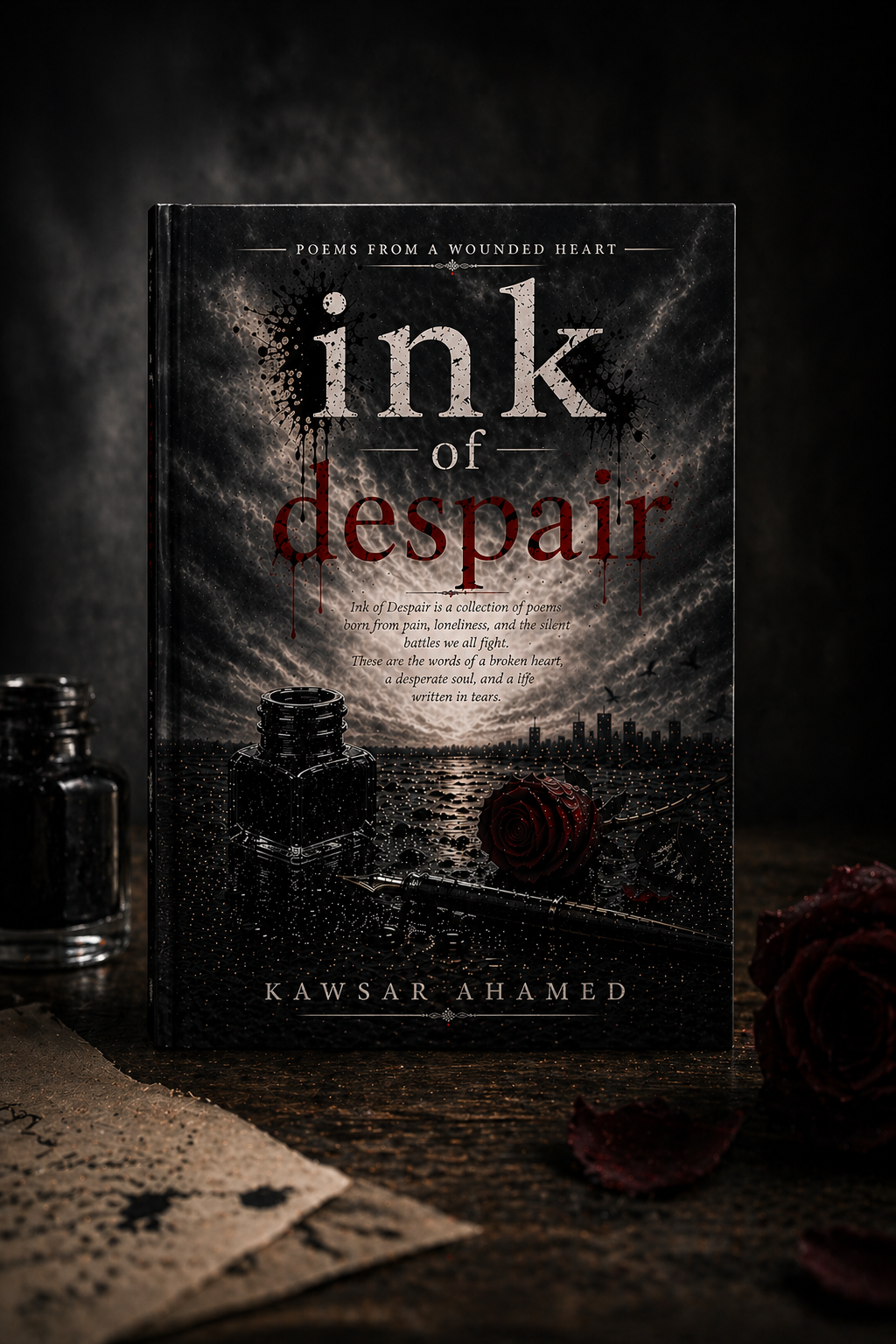
Order your paperback on Amazon: https://amzn.eu/d/06n7Elhw
Ink of Despair By Kawsar Ahamed
Summary of Living Corpse
By Kawsar Ahamed
Living Corpse is a free-verse poem that explores profound emotional suffering, hopelessness, and the gradual loss of identity. Addressed to a figure named Sameer, the speaker reflects on a life devastated by inner pain, describing a state in which physical existence continues but emotional and spiritual vitality has disappeared. Sleep no longer brings dreams, the heart remains restless, and each passing day deepens the speaker’s wounds.
The central metaphor of the “living corpse” symbolizes a person who is biologically alive yet emotionally and psychologically dead. The poem portrays isolation, exhaustion, and resignation as the speaker abandons hope, withdraws from human connection, and accepts darkness as a permanent companion. Rather than seeking rescue, the speaker acknowledges that inner fractures cannot be repaired by external comfort.
In its closing lines, the poem contemplates the fading of memory and identity, suggesting that the speaker has already vanished long before physical death, leaving behind only a name and a voice dissolving into silence. Through simple yet poignant language, Living Corpse captures the experience of profound emotional emptiness and the quiet erosion of the self.
Order the full book here: https://amzn.eu/d/06n7Elhw