If you are preparing for the Duolingo English Test, you have probably heard about the Production score. This score measures how well you can produce language through speaking and writing, which are two of the most important skills for studying in an English-speaking environment. Many test takers focus heavily on reading and listening, but improving your production ability can significantly boost your overall score.
A strong production score shows that you can express ideas clearly, organize your thoughts, and communicate effectively in English. However, many candidates struggle with this part of the test because they feel nervous, run out of ideas, or lack confidence in speaking and writing quickly.
The good news is that improving your production score is absolutely possible with the right strategies and consistent practice. In this guide, we will explore eight practical and proven ways to improve your production score in the Duolingo English Test in 2026, helping you perform better and increase your chances of achieving the score you need for university admission.
Improve your DET score with us
The Production subscore is perhaps the most important one because many schools and universities have a required minimum Production subscore. In addition, many students find Production challenging because it measures writing and speaking, the two hardest aspects of any language.
In this blog post, we’re going to look at some simple tips and tricks that will boost your score immediately. By the end, you’re going to be completely familiar with every Production question. Most importantly, you’ll know exactly how to do well on each one.
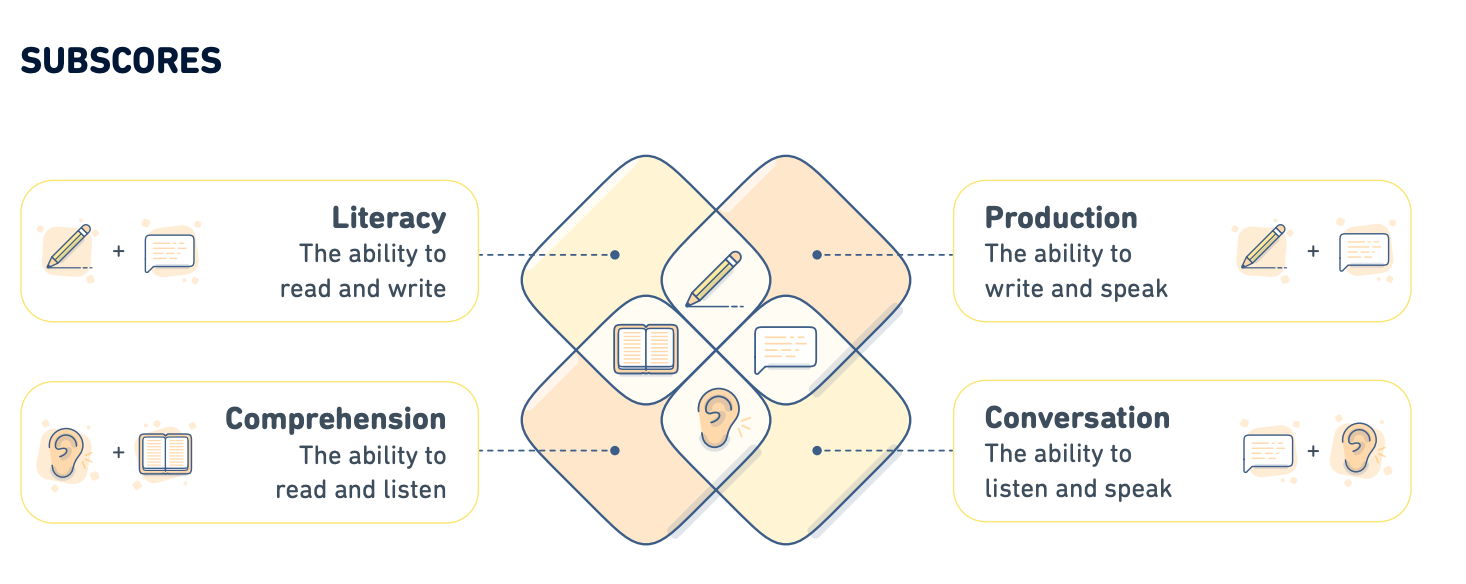
The Production subscore is 1 of the 4 subscores on the Duolingo English Test (DET), so it counts for 25% of your overall score.
The official Duolingo diagram that explains the 4 subscores of the Duolingo English Test
But what does “Production” mean exactly? Duolingo defines it as: “The ability to write and speak.” In other words, it’s your ability to produce English through both writing and speaking.
In April 2024, Duolingo changed the way they evaluate writing and speaking questions. Below are the new scoring criteria.
Content: Relevance, style, development, and effect on the reader
Discourse coherence: Clarity, cohesion, progression of ideas, and structure
Lexis (vocabulary): Lexical diversity, lexical sophistication, choice of words, formation of words, and spelling
Grammar: Grammatical complexity, grammatical accuracy, and punctuation
Fluency: Speed, natural use of pauses, and reliance on filler words, repetition, and starting/stopping
Pronunciation: Intelligibility, individual sounds, word stress, sentence stress, and intonation
Criteria 3 through 6 are all straightforward. But, the first two – “content and “discourse coherence” – are not as clear. These two criteria look at the ideas in your response. In short, Duolingo is looking for whether your ideas are easy to follow. Do you present a clear point of view? Do you provide clear supporting ideas? Is it easy to understand how one idea connects to the next?
Production questions are the hardest because you have to figure out what to talk about. But you also have to make sure that you don’t make grammar mistakes. That’s a lot to do in a very short time!
Having a strategy for each question type is helpful because it allows you to come up with what you’re going to talk about. This frees up your mind to focus on choosing the right words and avoiding grammar mistakes while you’re writing or speaking. You can’t memorize responses, but you absolutely should memorize the strategy for each question type. (When we look at each question type below, I will give you a specific strategy for each one.)
2. Focus on grammar
Making simple grammar mistakes will lose you the most points. But, these mistakes are also the easiest to fix!
Before spending a lot of time trying to learn advanced vocabulary and advanced grammatical structures, make sure that you consistently use correct grammar.
3. But also make sure you write enough
“Length” used to be an explicit part of the scoring criteria. This is no longer the case, but Duolingo still cares about the length of your response.
In 2023, Duolingo stopped specifying a word minimum for responses. This means that it isn’t obvious how much you should produce. Based on the experience of our students, here is what we recommend at Arno.
Write About the Photo => Minimum 30, over 50 if you need 130+
Interactive Writing (Part 1) => Minimum 120, over 150 if you need 130+
Interactive Writing (Part 2) => Minimum 90, over 100 if you need 130+
Writing Sample => Minimum 120, over 150 if you need 130+
Summarize the Conversation => Minimum 40, over 50 if you need 130+
If you write less than, Duolingo may deduct points from your response.
You need to be sure that not all of your sentences are “simple sentences.” Simple sentences start with the subject and the verb. For example:
I like dogs.
My school is far.
My favorite team won the championship.
The best way to use fewer simple sentences is to use connecting words. These are words that connect one idea to another and naturally result in more complex sentences. Here are examples.
And: I like football, and I like basketball.
But: I like football, but I don’t like handball.
So: I want to be healthy, so I run every morning.
Yet: The test was difficult, yet I passed.
However: We want to go for a walk. However, it is raining.
Which: We are getting pizza for dinner, which is my favorite food.
Because: I’m tired because I hiked a mountain yesterday.
Therefore: I didn’t sleep last night. Therefore, I’m tired today.
Moreover: I like going to the gym because it makes me feel healthy. Moreover, I see many friends there.
In fact: I love my house. In fact, it’s my favorite place in the world.
For example: There are many ways to raise your DET score. For example, you can make sure you have a plan for each question.
First, second, third: I prefer the beach to the mountains. First, the beach is warmer. Second, it never snows at the beach. Third, the beach is closer to my house.
In addition to: Cooking at home helps you eat more healthily, in addition to saving your money.
It’s important that you understand how to use these connecting words correctly. Otherwise, your writing will get worse, not better.
We recommend finding the translation of connecting words in your first language. This will enable you to immediately know how to use each one. With that knowledge, it’s just a matter of practicing with them so that you can use them confidently in the test.
5. Use synonyms
This helps you do better for the criterion “Lexis.”
An easy way to use a greater diversity of words is to spot words that you use a lot and find different words that have a similar meaning. It’s best if you understand the subtle differences between words; using exactly the right word is a strong indicator of your English skills.
Below is a list of words that are often overused and some of their synonyms.
Good
Great: Stronger than “good”
Terrific: Stronger than “great”
Tasty: Use “tasty” instead of “good” when describing food
Enjoyable: Use “enjoyable” instead of “good” when describing an experience or place
Bad
Terrible: Stronger than “bad”
Miserable: Stronger than “terrible”
Unpleasant: Use “unpleasant” instead of “bad” when describing an experience
Important
Noteworthy: Use “noteworthy” to describe a detail or person worth knowing about
Prominent: Use “prominent” to describe a person, company, or some entity that is well-known or powerful
Crucial, essential, critical: These all convey the idea that something is necessary
Like
Love: Stronger than “like”
Adore: Stronger than “love”
Enjoy: Use “enjoy” to describe food, places, or experiences
Small
Tiny: Smaller than “small”
Insignificant: Use “insignificant” to describe something that doesn’t matter
Large
Huge: Larger than “large”
Enormous: Larger than “large”
Sizable: An almost direct synonym for “large”
6. For writing questions, save time to review your response
You should think of writing and editing as 2 separate processes.
While you are writing, you are getting your ideas out. While you are editing, you are cleaning up your writing.
If you try to do both at the same time, you won’t do either well! On writing questions, for each minute, you should spend 50 seconds writing and 10 seconds editing.
For the Write About the Photo questions, you should spend 50 seconds writing and 10 seconds editing.
For the 5-minute Writing Sample and Interactive Writing (Part 1) questions, you should spend around 4 minutes writing and around 1 minute editing.
For Interactive Writing (Part 2), you should write for 2 minutes and 30 seconds and edit for 30 seconds.
For the 75-second Summarize the Conversation question, you should spend 1 minute writing 15 seconds editing.
While you are editing, look for typos and other obvious mistakes. Don’t get stuck trying to make one thing perfect. Focus on fixing the obvious, easy things.
7. For speaking questions, speak the entire time
In the speaking sections, there is no way to re-record your response or edit it. This is why most people dislike speaking questions the most!
A mistake that a lot of test takers make is that they don’t say enough. To avoid that, we recommend that you speak for the entire time. If you develop this habit as you prepare for the test, then you will also get more practice speaking.
If you think you won’t have enough to talk about, don’t worry. Once you master the strategies for these questions and you follow the final tip below, you’ll be fine 🙂
8. For speaking questions, slow down and enunciate
When you get stressed or nervous, you will naturally speak more quickly. You need to train yourself to slow down. This will allow you to really focus on pronouncing words well, which is called “enunciation” in English.
Slowing down also means that it’s easier to speak for the entire time!